

Egg Retrieval Recovery, Process & Egg Quality Guide India 2026

Egg Retrieval Recovery, Process & Egg Quality Guide India 2026

Written by DivinHeal Editorial Contributor, Samrat Nilesh, Embryologist | Medically Reviewed by Dr Indu Priya, Gynecologist(MBBS,MD) Published on: 2026-05-24
Egg Retrieval Recovery, Process & How to Improve Egg
Quality: Your Complete India Guide (2026)
Egg retrieval in India costs ₹1,00,000–₹3,00,000
($1,045–$3,135) as a standalone—70–85% less than private clinics in the UAE,
Australia, or the UK. At JCI-accredited hospitals like Apollo Fertility in
Delhi and Fortis Bloom IVF in Mumbai, you get expert fertility specialists and
same-week appointments. There are no waiting lists. This guide walks you
through the egg retrieval process step by step. It covers recovery day by day,
how to improve egg quality, and how to spot signs of poor egg quality.
Around
1 in 6 couples worldwide experience fertility challenges, according to the WHO
(2023). If you’re starting IVF for the first time—or going through it again
after a difficult cycle—it can feel like a lot to take in. Having a clear
understanding of the process can make things feel more manageable, helping you
feel better prepared, make informed choices, and take care of yourself along
the way.
|
Treatment |
India (INR) |
India (USD) |
Saving vs UAE |
Saving vs AU/UK |
|
Egg Retrieval (standalone) |
₹1,00,000–₹3,00,000 |
$1,045–$3,135 |
70–80% |
70–85% |
|
Full IVF Cycle (incl. retrieval) |
₹1,20,000–₹3,00,000 |
$1,254–$3,135 |
70–80% |
65–80% |
|
Medication (ovarian stimulation) |
₹50,000–₹1,50,000 |
$522–$1,567 |
60–70% |
60–75% |
|
PGT-A (genetic embryo screening) |
₹50,000–₹1,80,000 |
$522–$1,881 |
65–75% |
65–80% |
These
are approximate private healthcare costs for 2025–2026. Final prices may vary
depending on the hospital, the doctor’s experience, and your specific medical
situation.
Plan My Journey
Tell us your condition and budget — our AI matches the right destination, hospital and doctor and visa pathway
What Is
the Egg Retrieval Process? Step-by-Step Guide
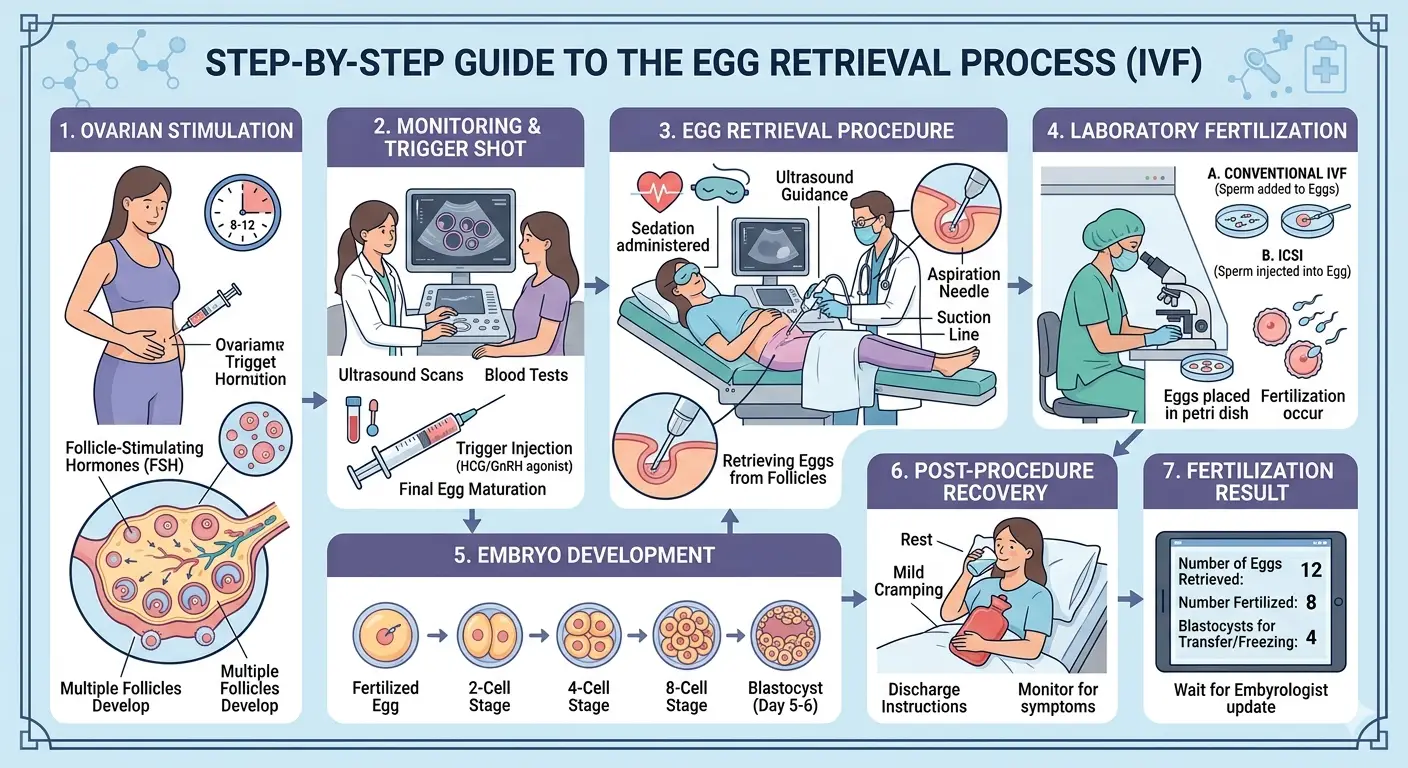
Egg retrieval, or oocyte
retrieval, is the part of IVF or egg freezing where mature eggs are collected
from your ovaries. It begins a couple of weeks earlier with hormone injections
to help your ovaries produce multiple eggs. The actual procedure on collection
day is fairly quick, usually taking about 20–30 minutes.
Step 1:
Pre-Retrieval Preparation and Ovarian Stimulation (Days 1–14)
Ovarian
stimulation uses daily hormone injections—FSH (follicle-stimulating hormone)
and LH (luteinising hormone). These help your ovaries grow several mature
follicles. In a natural cycle, you only release one egg. This phase runs for
10–14 days.
Your fertility team monitors your
response closely with blood tests and ultrasound scans every 2–3 days. These
scans help track how the follicles are growing and when they’re ready. Once the
leading follicles reach about 17–20 mm, you’re close to egg retrieval. Around
36 hours before the procedure, you take a trigger injection (hCG or a GnRH
agonist) to help the eggs mature and time the collection precisely.
During
this phase, your lifestyle affects egg quality directly. A Mediterranean-style
diet, no alcohol, no smoking, and lower stress all help your ovaries. Your
specialist at any JCI-accredited centre in India will build a plan for you.
They will adjust doses based on your AMH levels, AFC count, and past cycle
responses.
Step 2: The Egg
Retrieval Procedure (Day 14–16)
Egg
retrieval is a short daycase operation. It is done under light sedation or
general anaesthesia—you feel no pain. You lie down, and the specialist uses an
ultrasound probe to guide a thin needle into each follicle. The fluid—which
holds the eggs—is gently drawn out and sent straight to the embryology lab.
The
whole thing takes 20–30 minutes. Afterwards, you rest in a recovery room for
1–2 hours. You cannot drive that day—a responsible adult must take you home.
Most patients find it less uncomfortable than they expected.
Step 3: What
Happens to Your Eggs in the Lab?
Right
after collection, an embryologist checks each egg’s maturity under a
microscope. Mature eggs (metaphase II oocytes) are then either:
• Fertilised with sperm via
standard IVF (eggs and sperm combined in a dish)
• Fertilised via ICSI
(Intracytoplasmic Sperm Injection)—one sperm is injected into each egg. This is
used when sperm quality is a concern.
• Vitrified (flash-frozen) for
future use if you’re doing an egg freeze cycle
Fertilised
eggs are watched over 5–6 days as they grow into blastocysts (day-5 embryos).
The strongest blastocysts are chosen for transfer or frozen. Preimplantation
Genetic Testing (PGT-A) can screen embryos for chromosomal problems before
transfer. This is especially useful for women over 35.
How Many Eggs
Are Retrieved During IVF, on Average?
The
number of eggs retrieved varies from person to person. Most clinics collect
8–15 mature eggs per cycle in women with a normal ovarian reserve. Factors that
affect how many eggs you get include:
• Age: egg count and quality drop
naturally from your mid-30s onward
• AMH level: a key marker of
ovarian reserve. Higher AMH usually means a better response to stimulation.
• AFC (Antral Follicle Count):
the number of small resting follicles seen on ultrasound at the start of your
cycle
• Previous stimulation response:
ovarian reserve testing in India guides your dose adjustments
Retrieving
10–15 eggs is a good result for an IVF cycle. The number alone doesn’t decide
success—quality matters more. A study in Fertility and Sterility (2011) found
that 15 eggs gives the best balance of live birth rate and safety from ovarian
hyperstimulation syndrome (OHSS).
Planning your cycle? Contact Divinheal
for a free consultation. You’ll receive a personalised cost estimate and
hospital shortlist within 24 hours.
Egg
Retrieval Recovery: Timeline, Pain Management & Do’s and Don’ts
Most patients feel well enough for light activity within 1–2 days of
egg retrieval. Full recovery—when all discomfort is gone—takes 5–7 days. Here
is what to expect at each stage.
Recovery
Timeline: Day by Day After Egg Retrieval
|
Timeframe |
What You’ll Experience |
What to Do |
|
Day 0 (procedure day) |
Mild cramping, bloating,
light spotting, and sometimes nausea or dizziness from sedation. You may also
feel a bit drowsy right after the procedure. |
Rest at home and take
your prescribed paracetamol if you need it. Drink plenty of water and
electrolytes, and avoid driving right after the procedure. |
|
Day 1–2 |
Cramping often feels
similar to period pain, and bloating is common as the ovaries settle after
the procedure. Light spotting can also continue for a short time. |
Light activity is
fine—short walks can actually help you feel better. You can shower, but avoid
baths for a few days. Keep staying hydrated and follow your pain relief
schedule. |
|
Day 3–5 |
These symptoms usually
ease within 3–5 days, though a little bloating may last longer. |
You
can go back to light work when you feel ready, but avoid heavy exercise,
strenuous activity, or lifting anything heavy until you’ve fully recovered. |
|
Day
6–14 |
Most
people feel back to normal soon after, and their period typically returns in
about 7–10 days |
Avoid
intercourse and tampons for at least 2 weeks (or as advised). Avoid alcohol
until the doctor confirms it is safe. |
Recovery timelines
vary from person to person. Patients with OHSS (see
below) may take longer or feel more discomfort.
Pain Management and
Aftercare at Home
Once
you’re back at your accommodation, rest is the priority. Your doctor will
prescribe paracetamol (acetaminophen) for cramps. Avoid ibuprofen and other
NSAIDs unless your doctor says it is safe—they may affect implantation. A warm
heat pack on your lower abdomen helps with comfort.
Stay
well-hydrated—water and electrolyte drinks help with bloating. Eat light meals
for the first 24–48 hours. If you’re staying near a Divinheal partner hospital
in Delhi or Mumbai, your patient coordinator is available by phone throughout
your recovery.
Do’s
and don’ts summary:
✓ Rest for at least 24 hours after the procedure and
don’t push
yourself
✓ Take your pain relief exactly as prescribed, on time
✓ Drink plenty of water and include electrolytes to
stay hydrated
✓ Shower is fine, but avoid baths for at least 48 hours
(or as your specialist advises)
✗ Don’t engage
in strenuous exercise or lift more than 5 kg for at least one week
✗ Don’t use tampons or have
intercourse for at least 2 weeks (reduces infection risk)
✗ Don’t drink alcohol until
your specialist says it is safe—usually 1–2 weeks
✗ Don’t take ibuprofen or
aspirin unless your doctor prescribes them
Warning Signs:
When to Call Your Doctor After Egg Retrieval
Most
women recover without problems. But get medical help right away if you notice
any of the following. They may be signs of OHSS (Ovarian Hyperstimulation
Syndrome) or infection:
• Severe or worsening belly pain
that paracetamol doesn’t help
• Severe belly bloating—clothes
feeling tight at the waist
• Nausea and vomiting that do not
stop
• Reduced urination or
dark-coloured urine
• Shortness of breath or chest
tightness
• Fever above 38°C (100.4°F)
• Heavy vaginal bleeding (more
than a normal period)
OHSS
is a rare but serious condition. It happens when your ovaries over-respond to
hormones, causing fluid to build up in your abdomen. Mild OHSS is common and
goes away on its own. Severe OHSS needs medical care. JCI-accredited hospitals
in India use strict monitoring to lower this risk.
All
Divinheal partner hospitals have 24-hour emergency lines. Your coordinator will
give you contact numbers before you leave the hospital.
Signs of
Poor Egg Quality: How to Identify and Address Them
Poor egg quality is one of the main causes of IVF failure and
recurrent miscarriage. Eggs can’t be rated good or poor without lab analysis.
So most signs show up as fertility problems, not physical symptoms you can
feel.
What Are the Signs
of Poor Egg Quality?
Signs
that may indicate poor egg quality include:
• Recurrent miscarriage (two or
more losses in a row, especially before 10 weeks)
• Failed IVF cycles even when
embryos looked healthy—they don’t implant or stop growing early
• High rate of chromosomal
problems in embryos (aneuploidy), found through PGT-A
• Poor embryo development in the
lab—eggs don’t fertilise, or embryos stop growing before the blastocyst stage
• Low AMH levels or AFC count,
pointing to a lower ovarian reserve
• High FSH (follicle-stimulating
hormone) on day 2–3 of your cycle. This means the pituitary gland is working
harder than normal to stimulate the ovaries.
By
age 40, over 50% of eggs carry chromosomal problems (American Society for
Reproductive Medicine, 2023). This condition—aneuploidy—is the main cause of
implantation failure and early miscarriage in older patients. PGT-A at
JCI-accredited IVF labs in India screens embryos before transfer. This greatly
improves the chance of a healthy pregnancy.
What Is a Good
AMH Level to Get Pregnant?
AMH
(Anti-Müllerian Hormone) is one of the main blood tests used to estimate
ovarian reserve. It helps give an idea of how many eggs are likely remaining in
the ovaries. AMH levels naturally change with age, and typical ranges are often
looked at in that context:
|
Age |
Good AMH Level |
Low (action needed) |
Very Low |
|
25 years |
Above 3.0 ng/mL |
1.0–2.0 ng/mL |
Below 1.0 ng/mL |
|
30 years |
Above 2.5 ng/mL |
1.0–1.5 ng/mL |
Below 1.0 ng/mL |
|
35 years |
Above 1.5 ng/mL |
0.5–1.0 ng/mL |
Below 0.5 ng/mL |
|
40 years |
Above 1.0 ng/mL |
0.5–0.8 ng/mL |
Below 0.5 ng/mL |
|
45 years |
Above 0.5 ng/mL |
0.3–0.5 ng/mL |
Below 0.3 ng/mL |
AMH
is measured with a simple blood test. You can get results on the same day at
JCI-accredited fertility centres in India.
A
regular menstrual cycle—consistently 21–35 days—suggests healthy hormones and
good ovarian function (FertilityFamily, 2025). Cycles that have become shorter
over time can be a sign of declining ovarian reserve.
Can You Get
Pregnant with Poor Egg Quality?
Yes—with
the right approach. Poor egg quality is not a full barrier to pregnancy. But it
needs a targeted plan:
• Lifestyle changes and
supplements (at least 3 months) improve the environment where eggs grow
• A personalised stimulation plan
can improve the number of good-quality eggs retrieved
• PGT-A screening picks only
chromosomally normal embryos for transfer. This greatly improves implantation
rates when egg quality is low.
• Donor egg IVF is an option when
your own eggs cannot produce viable embryos.
Fertility
specialists at Apollo Fertility and Fortis Bloom IVF in India have wide
experience with hard cases—including Diminished Ovarian Reserve (DOR) and
recurrent implantation failure. Ovarian PRP (Platelet-Rich Plasma) therapy is
available at select centres for patients with poor ovarian response. Early
evidence suggests it may help in certain cases (Journal of Clinical Medicine,
2022).
How to
Improve Egg Quality: Natural, Nutritional & Medical Approaches
Improving
egg quality doesn’t happen overnight—it usually takes about 3 months. That’s
because each egg needs roughly 90 days to develop before it’s ready for
ovulation. Small, steady changes in your lifestyle, diet, and any treatment
your doctor recommends during this time can really make a difference.
Lifestyle and
Diet: What Foods Help and Harm Egg Quality?
Diet
is one of the most powerful tools for egg quality. A Mediterranean-style diet
has the strongest evidence for fertility benefit:
• Eat: leafy greens (spinach,
kale), colourful vegetables, whole grains, legumes, lean proteins, oily fish,
olive oil, and nuts
• Eat: antioxidant-rich berries,
citrus fruit, and tomatoes. Antioxidants protect eggs from oxidative stress—a
main driver of chromosomal damage.
• Limit: red and processed meats
(linked to lower IVF success rates), refined carbohydrates, and added sugars
• Avoid: Try to avoid trans fats, which are commonly found in fried and
processed packaged foods and have been linked with lower fertility (British
Fertility Society guidelines).
• Avoid: It’s also best to avoid smoking and keep alcohol to a minimum, as
both can negatively affect egg quality and hormone balance (WHO, 2022).
By
age 30, women have typically lost around 90% of their original egg supply
(Audubon Fertility). This doesn’t mean fertility is over. But it shows why
protecting egg quality matters—especially from your early 30s onward.
Regular, moderate exercise—about 30
minutes most days—can help improve blood flow to the reproductive organs and
support overall fertility. At the same time, ongoing stress can raise cortisol
levels, which may interfere with the hormones needed for follicle growth. Simple
habits like yoga, mindfulness, or even a gentle daily walk can go a long way in
helping the body relax and restore balance.
At What Age Are
90% of Your Eggs Gone? (And What It Means for You)
Research
suggests women lose around 90% of their egg supply by age 30, and 97% by age 40
(Audubon Fertility). This is a natural process—it cannot be reversed. But the
eggs that remain can still be high quality and lead to healthy pregnancies.
What
matters is not how many eggs are lost, but how good the remaining ones are.
This is why both quantity (AMH, AFC) and quality markers (fertilisation rate,
embryo development, chromosomal screening via PGT-A) are checked during IVF.
Women over 38 or those with low AMH may benefit from a stronger stimulation
plan to retrieve the most eggs per cycle.
Targeted
Supplements: CoQ10, Folic Acid, DHEA & Omega-3
Certain supplements have good research
behind their role in egg quality. Always discuss with your fertility specialist
before starting any supplement:
|
Supplement |
Role in Egg Quality |
Typical Dose (consult specialist) |
|
CoQ10 (Ubiquinol) |
A powerful antioxidant
that helps support energy production in egg cells, especially useful after
age 35. |
200–600 mg/day |
|
Folic Acid / Methylfolate |
Plays
an important role in DNA formation and healthy cell division, helping reduce
chromosomal errors |
400–800 mcg/day |
|
DHEA |
May
help improve ovarian response in women with diminished ovarian reserve (DOR);
often prescription-only in some countries
|
25–75 mg/day (specialist prescription) |
|
Omega-3 fatty acids |
Supports
a healthy inflammatory balance and may improve blood flow to the ovaries and
follicle development |
1–2 g/day (EPA+DHA) |
|
Vitamin D |
Some
evidence and clinical guidance (including ASRM) suggest it may support IVF
outcomes and hormonal balanceLinked |
1,000–2,000 IU/day (based on blood levels) |
|
Myo-inositol |
Supports ovarian function; particularly beneficial for women with
PCOS |
2–4 g/day |
Supplements
support—but do not replace—a healthy diet and medical plan. Your specialist at
a JCI-accredited IVF centre in India will match recommendations to your
specific bloodwork and fertility profile.
Egg
Retrieval and IVF Cost in India vs UAE, Australia & UK (2026)
India has JCI-accredited hospitals, internationally trained
specialists, and much lower costs. This makes it one of the most cost-effective
places in the world for fertility treatment. Here is a breakdown of what you’ll
pay—and what you’ll save.
|
Treatment |
India |
UAE (AED) |
Australia (AUD) |
UK (GBP) |
|
Egg Retrieval (standalone) |
$1,045–$3,135 |
AED 25,000–40,000 |
AUD 8,000–15,000 |
GBP 3,000–6,000 |
|
Full IVF Cycle |
$1,254–$3,135 |
AED 30,000–50,000 |
AUD 8,000–15,000 |
GBP 6,000–10,000 |
|
Medication (stimulation) |
$522–$1,567 |
AED 5,000–18,000 |
AUD 2,000–4,000 |
GBP 1,500–3,500 |
|
Approximate Saving vs India |
N/A — Baseline |
70–80% |
65–80% |
65–80% |
All figures are approximate private-healthcare ranges for 2025–2026.
UAE figures are for private clinics in Dubai. Australia figures are for private
IVF (Medicare rebates may apply for some Australian residents). UK figures are
for private HFEA-licensed clinics. Verify with live hospital quotes before
booking.
In the UK, patients on NHS
waiting lists often wait 12–18 months or even longer before treatment starts.
In Australia, waiting times can also be significant, and private IVF typically
costs around AUD 8,000–15,000 per cycle after Medicare support. In the UAE, IVF
in Dubai usually ranges from AED 30,000–50,000 per cycle (about $8,169–13,615).
In comparison, India is
often chosen for its quicker access to appointments, shorter waiting times, and
more affordable treatment costs, along with well-established fertility centres.
IVF costs in India cover the initial consultation, stimulation monitoring, egg retrieval,
embryology, and basic follow-up. Most Divinheal partner hospitals in Delhi and
Mumbai include 2 nights’ accommodation in their international patient packages.
Divinheal arranges airport transfers, accommodation near the hospital, and a
local coordinator for every international patient.
Emotional
Well-being During Fertility Treatment: Coping and Support
The emotional side of fertility treatment matters just as much as
the medical side. Around 40–50% of women going through IVF feel anxiety or
depression at some point during treatment (Human Reproduction, 2012). Knowing
this—and building support around it—is part of good fertility care.
Sarah, 38, from London, felt really overwhelmed after her second failed IVF cycle. “I had done everything right, but it still didn’t work. The hardest part was not knowing why,” she said. (Illustrative composite based on typical patient journeys; name changed for privacy.) On her third cycle in India, her doctor picked up a chromosomal abnormality pattern through PGT-A testing and suggested changing the plan. That one discussion ended up changing the direction of her treatment.
Support Systems and
Coping Strategies
Effective
support during fertility treatment includes:
• Integrated counselling: Many JCI-accredited hospitals in India include
fertility counsellors as part of their international patient support, so
emotional support is built into the care journey as well.
• Arabic-speaking coordinators: Through
Divinheal’s partner hospitals, UAE patients can get support in Arabic, making
communication and the process easier.
• Online communities: Patient forums can
help you feel less alone by connecting you with others going through similar
experiences.
• Mindfulness and gentle movement: Activities like yoga, walking, or
meditation can help reduce stress and support hormonal balance.
• Partner involvement: Many clinics also offer joint counselling sessions
for couples, helping both partners feel more involved and supported.
Divinheal’s
patient support team stays in contact throughout your treatment—not only on the
day of your procedure. Every international patient has a named coordinator
available by WhatsApp or phone from arrival to follow-up.
Why
Choose India for Egg Retrieval? Quality, Accreditation & Divinheal Support
India has become a major
destination for fertility treatment, and for many patients the reasons are
quite practical—JCI-accredited hospitals, experienced specialists trained
internationally, and advanced embryology labs. On top of that, treatment is
often much more affordable, sometimes around 65–85% lower than private care in
the UAE, Australia, or the UK.
Hospital
Accreditations and Specialist Credentials
JCI (Joint Commission International)
accreditation is widely recognised as a global standard for hospital quality
and safety. It focuses on areas like patient safety, treatment outcomes,
infection control, and staff qualifications. In India, over 40 hospitals are
JCI-accredited, including centres such as Apollo Fertility, Fortis Bloom IVF,
and Manipal Hospitals.
Many fertility specialists at
Divinheal’s partner hospitals are also internationally trained, holding
qualifications like MRCOG (UK), FCPS, or fellowships from the US and Australia.
The embryology labs use advanced technologies such as IVF Witness systems,
time-lapse embryo monitoring (EmbryoScope), and vitrification techniques that
match standards seen in leading clinics in London, Sydney, and Dubai.
How Divinheal
Supports You From Consultation to Follow-Up
Divinheal’s role begins even before
you travel. The process typically looks like this:
• Share your medical history online (AMH results, previous cycle reports,
diagnosis) so the team can review everything in advance and plan your care
accordingly
• Get a personalised shortlist of hospitals and a clear cost estimate
within 24 hours
• Have a virtual consultation with your specialist before travelling, so
the plan is already mapped out
• Divinheal supports with visa guidance, flights, and accommodation near
the hospital
• On arrival in India, any needed tests are done on day one, and treatment
starts soon after
• Egg retrieval is done at a JCI-accredited hospital at the planned time
in your cycle
• During recovery, your coordinator stays in touch and is available whenever you need support
• Once you’re home, you receive discharge instructions and follow-up consultations at 2 weeks and 3 months
Nadia, from Dubai, spent about 3 weeks at Apollo Fertility in Delhi for a full IVF cycle, including egg retrieval and PGT-A. Her total cost was ₹4,20,000 (around $4,388 / AED 16,117)—almost 70% less than what the same treatment would cost at a private clinic in Dubai, while still being treated in a high-standard lab with experienced specialists. (Illustrative composite; name changed for privacy.)
Ready to start? Contact Divinheal for a
free, no-obligation consultation. Receive a personalised treatment plan and
cost estimate within 24 hours.
Cost Calculator
I know my treatment — show me cost from 3 hospitals
Quick Answer — At a
Glance
Skim this if you’re short on time.
|
Egg retrieval recovery typically
takes 1–2 days to resume light activity and 5–7 days for full recovery. The egg
retrieval process spans 2–4 weeks: 10–14 days of ovarian stimulation
injections, monitoring scans every 2–3 days, a 36-hour trigger injection,
and a 20–30 minute procedure under sedation. In India, egg retrieval costs
₹1,00,000–₹3,00,000 ($1,045–$3,135) at JCI-accredited hospitals—saving
70–85% vs UAE, Australia, or UK private clinics. To improve egg quality,
allow 3 months: Mediterranean diet, CoQ10 (200–600 mg), folic acid,
omega-3s, and stress management. Signs of poor egg quality include
recurrent miscarriage, failed IVF implantation, low AMH, and high FSH. PGT-A
genetic screening at India’s
JCI labs identifies chromosomal issues before transfer. At a glance: Egg
retrieval cost in India: ₹1,00,000–₹3,00,000 (standalone) │
₹1,20,000–₹3,00,000 (full IVF cycle) Recovery: Light activity in 1–2 days │
Full recovery in 5–7 days │ Period usually returns in 7–10 days Average eggs
retrieved: 8–15 per cycle (depending on age, AMH, and response to
stimulation) Egg quality improvement: Usually takes at least 3 months, since
that’s the natural follicle development cycle Possible signs of poor egg
quality: Recurrent miscarriage, failed implantation, low AMH, high
FSH Savings vs UAE private: 70–80% │ vs Australia private: 65–80% │ vs UK
private: 65–80% |
Medically reviewed for accuracy. Individual outcomes vary. Consult
your specialist for personalised advice.
Plan My Journey
Tell us your condition and budget — our AI matches the right destination, hospital and doctor and visa pathway
Cost Calculator
I know my treatment — show me cost from 3 hospitals
Recommended Article


IVF Treatment in Haryana | Cost, Hospitals & Doctors
IVF Treatment in Haryana | Cost, Hospitals & Doctors
IVF Treatment in Haryana | Cost, Hospitals & Doctors
IVF Treatment in Haryana | Cost, Hospitals & Doctors
IVF Treatment in Haryana | Cost, Hospitals & Doctors
IVF Treatment in Haryana | Cost, Hospitals & Doctors
IVF Treatment in Haryana | Cost, Hospitals & Doctors
IVF Treatment in Haryana | Cost, Hospitals & Doctors
IVF Treatment in Haryana | Cost, Hospitals & Doctors
IVF Treatment in Haryana | Cost, Hospitals & Doctors
Written by DivinHeal Editorial Contributor, Samrat Nilesh, Embryologist | Medically Reviewed by Dr Indu Priya, Gynecologist(MBBS,MD) Published on: 2026-05-24
Plan My Journey
Tell us your condition and budget — our AI matches the right destination, hospital and doctor and visa pathway
Cost Calculator
I know my treatment — show me cost from 3 hospitals
Booking With DIVINHEAL
Get a free consultation to understand your treatment options
Recommended Article
IVF Treatment in Haryana | Cost, Hospitals & Doctors
IVF Treatment in Haryana | Cost, Hospitals & Doctors
IVF Treatment in Haryana | Cost, Hospitals & Doctors
IVF Treatment in Haryana | Cost, Hospitals & Doctors
IVF Treatment in Haryana | Cost, Hospitals & Doctors
IVF Treatment in Haryana | Cost, Hospitals & Doctors
IVF Treatment in Haryana | Cost, Hospitals & Doctors
IVF Treatment in Haryana | Cost, Hospitals & Doctors
IVF Treatment in Haryana | Cost, Hospitals & Doctors
IVF Treatment in Haryana | Cost, Hospitals & Doctors
From Consultation to Recovery,
Step by Step
Expert Specialist Matching
Connecting you with the world's top-rated medical experts.
Accredited Hospital Network
Access to JCI & NABH certified healthcare facilities.
Complete Travel Coordination
Hassle-free visa, stay, and local transport assistance.
24/7 Personal Care
Dedicated patient advisors supporting you at every step.
Journey Guidance
Full guidance from start to end of the patient treatment journey.
Expert Specialist Matching
Connecting you with the world's top-rated medical experts.
Everything you
need to know today
Browse through these common inquiries to better understand our patient-focused medical platform.
Egg retrieval as a standalone costs ₹1,00,000–₹3,00,000 ($1,045–$3,135) at JCI-accredited hospitals. A complete IVF cycle—including stimulation medication, retrieval, embryology, and basic follow-up—costs ₹1,20,000–₹3,00,000 ($1,254–$3,135). This is 65–85% less than equivalent private treatment in the UAE (AED 30,000–50,000), Australia (AUD 8,000–15,000), or the UK (GBP 6,000–10,000).
The whole IVF process usually takes around 2–4 weeks. In the first 1–2 weeks, you’ll have your initial consultation, baseline blood tests and an ultrasound, and then begin ovarian stimulation injections. In the next phase (week 2–3), you continue daily injections, with scans every 2–3 days to check how your follicles are developing. Around days 14–16, you take a trigger injection about 36 hours before egg retrieval to time everything precisely. Egg retrieval itself is a quick procedure—around 20–30 minutes under sedation. After that, the eggs go to the lab, where embryos develop over 5–6 days before being transferred or frozen.
No—the procedure is done under light sedation or general anaesthesia, so you feel nothing during it. Afterwards, most patients feel cramping similar to a heavy period and some bloating. This usually clears within 3–5 days. Paracetamol manages the discomfort well. Avoid ibuprofen and NSAIDs unless your doctor prescribes them, as they may affect implantation.
Most patients return to light activity within 1–2 days. Cramping and bloating usually ease within 3–5 days. You should feel fully normal by the time your next period arrives—usually 7–10 days after retrieval. Avoid strenuous exercise and heavy lifting for at least one week. Avoid baths, intercourse, and tampons for at least 2 weeks.
Do: rest on procedure day, take paracetamol as prescribed, drink plenty of water, shower (not bath), eat light meals. Don’t: drive on procedure day, take ibuprofen/aspirin, do strenuous exercise or lift more than 5 kg for a week, use tampons or have intercourse for 2 weeks, drink alcohol until your specialist says it is safe.
Try following a Mediterranean-style diet that’s rich in antioxidant and anti-inflammatory foods. Take supplements only as advised by your specialist—commonly CoQ10 (200–600 mg), folic acid (400–800 mcg), and omega-3s, which are often used to support egg health. Stay active with light to moderate exercise, like 30 minutes most days, and avoid smoking while keeping alcohol to a minimum. For stress, simple habits like yoga, mindfulness, or even daily walks can help more than you’d expect. And give it time—around 3 months—for these changes to start making a real difference, since that matches the natural egg development cycle.
Clinical signs can include things like repeated miscarriages, embryos that don’t reach the blastocyst stage, repeated IVF failures, or higher rates of abnormalities seen on PGT-A testing. Doctors also look at key markers such as low AMH, high day-3 FSH, and a low AFC. By age 40, it’s estimated that over 50% of eggs may have chromosomal abnormalities (ASRM, 2023). A detailed evaluation at a fertility clinic—like a Divinheal partner hospital—helps piece this together and guide a more personalised treatment plan.
Some foods are linked with lower egg quality and reduced fertility, especially when they’re part of the diet over a long period. These include processed and red meats, trans fats found in fried and packaged foods, refined carbs and sugary foods, and excessive alcohol. Frequent fast-food intake has also been associated in some studies with lower IVF success rates. Over time, these eating patterns can contribute to weight gain, and obesity itself can affect egg quality by disrupting hormone balance.
Here are commonly used AMH ranges by age: above 3.0 ng/mL at 25, above 2.5 ng/mL at 30, above 1.5 ng/mL at 35, above 1.0 ng/mL at 40, and above 0.5 ng/mL at 45. If levels are below these ranges, it may suggest a reduced ovarian reserve and is usually a reason to consult a fertility specialist. In India, many JCI-accredited fertility labs also offer same-day AMH testing, which can speed up the initial evaluation. And even with low AMH, pregnancy is still possible with a personalised treatment plan—AMH is mainly a guide for planning, not a final outcome.
Not in the same cycle. After egg retrieval, your body usually needs time to recover before an embryo transfer. In a fresh transfer, the embryo is typically placed back 3–5 days after retrieval. In a frozen transfer cycle, you rest first—usually for about 4–6 weeks—before starting the next step. Right after retrieval, hormone levels are still elevated, so while fertility may feel temporarily higher, natural conception during this time isn’t recommended or considered safe.
OHSS (Ovarian Hyperstimulation Syndrome) happens when the ovaries react too strongly to fertility medications, causing fluid to build up in the abdomen. Mild symptoms—like bloating or mild discomfort—are fairly common (up to about 33% of IVF cycles) and usually settle on their own. Moderate to severe OHSS is rare, around 1–2% of cases, but it does need medical attention. Warning signs to watch for include strong abdominal bloating, reduced urination, sudden weight gain (more than 2 kg in 24 hours), nausea, vomiting, or shortness of breath. If any of these happen, you should contact your clinic straight away. Many Divinheal partner hospitals also offer 24/7 support lines for international patients, so help is available whenever you need it.
Yes. Divinheal guides every international patient through the Indian medical visa (MV) application: hospital invitation letter, medical summary, and application form. Visas typically process in 2–5 working days. Accommodation is arranged within 10 minutes of your hospital—serviced apartments or hotels near Apollo Fertility or Fortis Bloom IVF. Airport transfers and a local patient coordinator are included in all international packages. Post-return virtual follow-up consultations are arranged with your treating specialist.
Still have more questions?
Book a call with our friendly team to learn how DivineHeal simplifies your healthcare journey.


